

What Is an Incident Report in Healthcare?
An incident report in healthcare is a written record of an unexpected event. The event may have harmed a patient, a staff member, or the organization, or it may have come close to causing harm. The goal is simple: capture what happened while the details are fresh so the team can learn from it.
These reports cover more than serious injuries. They also record near-misses and events that reached a patient but caused no harm. Each of them holds useful information.
It helps to keep a few terms clear:
- Near-miss (or close call): an event that never reached the patient or was caught before it caused harm.
- No-harm event: an event that reached the patient but caused no injury.
- Adverse event: harm caused by care or its management, not by the patient’s own illness.
You may also hear “incident reporting” and “event reporting” used as if they have the same meaning. In many settings, they do. Where people draw a line, event reporting is the wider term that covers near-misses and adverse events, while incident reporting often points to events that caused harm or nearly did. Treat this as common practice, not a fixed rule.
Most incidents do not come from one careless act. They usually build from several factors at once, such as
- Miscommunication between staff or shifts
- Steps skipped or protocols not followed
- Staffing pressure and heavy workloads
- Gaps in training
- Systems or processes that are error-prone
Because of this, the fairest view treats most incidents as system problems. People still hold responsibility for reporting honestly and speaking up when they see a risk.
Types of Incident Reports in Healthcare
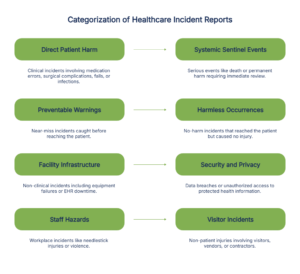
Not every incident report looks the same. Sorting them into types helps you respond at the right speed and spot patterns over time. Here are the main categories you will meet.
Clinical incidents
These come directly from patient care. They include medication errors, surgical complications, missed or delayed diagnoses, patient falls, pressure injuries, and hospital-acquired infections. Because they touch care itself, they often carry the highest risk to patients.
Near-miss incidents
A near-miss is caught before it reaches the patient. A pharmacist spotting an incorrect dose before it leaves the pharmacy is a near miss. These are gold for safety teams, since they reveal a weak point without anyone getting hurt.
No-harm incidents
Here the error reaches the patient but causes no injury. Maybe an extra non-urgent dose is given with no effect. The lack of harm does not remove the lesson, so these still deserve a report.
Sentinel events and “never events”
These are the most serious events, and the two terms are related but not the same.
- A sentinel event is Joint Commission language for a patient safety event that reaches a patient and results in death, severe harm, or permanent harm. It signals the need for an immediate review.
- “Never events” comes from the National Quality Forum’s list of Serious Reportable Events. These are serious, largely preventable events that should never happen.
Do not treat the two labels as interchangeable, since they come from different sources and different lists.
Non-clinical and operational incidents
These do not come from direct care but can still disrupt it. Think equipment failures, facility problems, power loss, or downtime in electronic health record (EHR) systems.
Security and privacy incidents
This group covers data breaches and unauthorized access to protected health information (PHI), which is any health data that can identify a patient. A privacy breach under HIPAA, the U.S. health data privacy law, belongs here, and it carries its own reporting duties (more on that later).
Workplace and staff-safety incidents
Healthcare staff face daily risks. This category covers needlestick injuries, exposure to hazardous substances, lifting injuries, and workplace violence.
Non-patient incidents
Not every incident involves a patient. Visitors, vendors, and contractors can slip, fall, or get hurt on-site, and those events still need a record for safety and liability reasons.
Examples of Incident Reports in Healthcare (Real-World Scenarios)
The clearest way to understand reporting is to look at common examples of incident reports in healthcare. Each scenario below shows the kind of event that triggers a report and why it matters.
Medication errors
Medication errors are the most commonly reported incidents in healthcare and a leading cause of avoidable harm worldwide. They include giving the wrong dose, the wrong drug, or missing a dose. A common case: a nurse scans a barcode, gets distracted, then picks up the wrong bottle. The report captures the mix-up so the team can find the weak step and fix it.
Patient falls
Falls can cause fractures, bleeding, and worse. Picture a patient who slips on a wet floor near the nurse’s station. The report records the events before and after the fall, plus any injury, so staff can review the environment and how the patient was monitored.
Surgical and procedural complications
Surgery carries risk even when done well. A retained instrument, a wrong-site procedure, or an unexpected problem after routine surgery all call for a report. A good report looks at the whole process, from prep to recovery.
Communication and handoff breakdowns
Many errors trace back to a missed message. A critical lab result that never reaches the doctor, or an unclear handover between shifts, can delay care. The report names the gap so it can be closed.
Patient misidentification
Correct identification keeps care safe. A patient given a test or drug meant for someone else, because of a wristband or name mix-up, needs a report that checks the identification steps.
Data breach or HIPAA privacy incident
If a staff member views records without permission, or PHI is sent to the wrong person, that is a reportable privacy incident. It can trigger duties under the HIPAA Breach Notification Rule.
Real-world case studies with outcomes
Two documented cases show how serious the harm can be when small failures line up, and why fast, honest reporting matters.
A colonoscopy prep mix-up (AHRQ case)
According to the AHRQ Patient Safety Network, an 81-year-old ICU patient with a gastrointestinal bleed was due to get a colonoscopy prep solution. A nurse, who was also caring for two other patients, picked a jug of dialysis fluid by mistake. When the barcode would not scan, the pharmacy sent a loose barcode label, which the nurse scanned and used. That workaround skipped the real safety check. The patient was given the fluid by mouth, then the rest through a feeding tube, and died hours later. The review pointed to heavy workload, distraction, and a barcode step that was worked around.
RaDonda Vaught
As reported by the National Library of Medicine, nurse RaDonda Vaught at Vanderbilt University Medical Center was asked to give a patient the sedative Versed before a PET scan. She looked for the drug in the automated cabinet by typing “VE” but found nothing, so she used a system override, typed “VE” again, and selected the first drug on the list, a paralyzing agent called vecuronium. There was no barcode scanner in the scan area to catch the mix-up, and she was distracted while preparing the drug.
The patient suffered a severe brain injury, and life support was withdrawn a day later. The hospital’s report to the medical examiner did not mention the error, listed the death as natural, and no sentinel event report was filed as required. The error surfaced nearly a year later through an anonymous report to a federal agency. Vaught lost her license and was convicted of negligent homicide and gross neglect.
The Incident Reporting Process, Step by Step
A good report follows a clear path, from the moment something goes wrong to the change that prevents it next time. Here is the process most healthcare teams follow.
Step | Main goal | Who is usually involved? |
Identify and document | Capture accurate facts | Staff who saw the event |
Submit | Start the review | Reporting staff |
Review and analyze | Judge impact and causes | Managers, safety team |
Find the underlying cause | Reach the source of the problem | Safety or quality team |
Take corrective action | Prevent a repeat | Leadership, department |
Follow up | Confirm the fix works | Quality and risk staff |
1. Identify and document the incident
Spot the event and write it down quickly. Record the date, time, location, people involved, and what was done right away. Fresh details are accurate details.
2. Submit the report through the right channel
Send the report through your organization’s approved system. Prompt submission starts the review sooner. Keep the report clear, factual, and free of opinion.
3. Review and analyze
The right person or committee reviews the report. They check what happened, judge the impact, and look for the factors that led to it.
4. Find the underlying cause (5 Whys, fishbone diagrams)
Teams dig past the surface to find why the event happened. Two common tools help. The 5 Whys asks “why” over and over until you reach the source. The fishbone diagram maps possible causes across people, processes, and equipment.
5. Take corrective action
Based on what the review finds, the team acts. That might mean updating a protocol, adding training, or changing a step in the workflow.
6. Follow up and update policy
Check that the fix worked. Track outcomes, gather staff feedback, and update policies and training so the lesson sticks.
Incident Severity Levels and How They Are Classified
Not all incidents carry the same weight. Grading them by severity helps teams respond fast to the worst events and track patterns across the rest.
The WHO harm-based approach
The World Health Organization grades harm by looking at the patient’s symptoms, how long the effects last, and the treatment needed as a result. This keeps the focus on the real impact on the person.
A practical severity scale
Many organizations use a simple scale that runs from minor to catastrophic. A common version looks like this:
Level | Description |
Minor / near-miss | Caught before harm, or no lasting effect |
Moderate | Some harm; extra monitoring or minor treatment needed |
Serious | Clear harm; needs quick action and review |
Severe | Major harm; full investigation and response |
Catastrophic | Death or permanent harm; harm; often called a “never event” |
Keep in mind that no single scale is used everywhere. The number of levels and the labels change from one organization or regulator to the next. Treat any 1-to-5 model as a common framework, not a legal standard.
What to Include in an Incident Report (Fields You Need)
A strong report answers who, what, when, and where in plain, factual language. Missing fields slow the review and weaken the record. Here is what belongs in every report.
- Basic details (date, time, location): Start with when and where the event happened. These simple facts place the event and help spot patterns, such as a ward with repeat falls.
- Individuals involved and witness statements: Name the people involved, including patients, staff, and any witnesses, with their roles. Witness accounts often reveal factors the main report misses.
- Objective description and incident type: Describe what happened in order, using facts only. State the type of event, such as a medication error or a fall, so it can be grouped and tracked.
- Immediate actions taken: Record what staff did right after the event, such as checking the patient, calling a doctor, or removing a hazard. This shows how the team responded.
- Contributing factors, outcome, and impact: Note what may have led to the event, such as short staffing or a faulty device. Then describe the result, including any harm and the effect on care.
- Corrective measures, reporter details, and follow-up: List the steps planned to stop a repeat. Record who filed the report, and leave room to track follow-up actions.
One rule runs through all of these fields: stick to facts. Opinions, blame, and guesses do not belong in the record. A factual report holds up better during review, audit, and any legal look-back.
What Happens After a Report Is Filed
Filing the report is the start, not the finish. What the team does next decides whether the problem returns.
Triage and prioritization
The safety or risk team reads the report and rates how urgent it is. This decides how fast to act and who needs to step in. Most teams sort reports by how much harm reached the patient and how likely the event is to happen again. A near-miss might go into routine review, while a death or serious harm moves straight to senior leaders and may start outside reporting the same day.
Investigation and finding the underlying cause
The team gathers facts, talks to those involved, and reviews the steps that led to the event. The aim is to find the real source, not just the surface mistake. For serious events, many hospitals run a formal review with tools like the 5 Whys or a fishbone diagram to trace each contributing factor. This work looks at the whole system around the person, such as staffing, training, equipment, and communication, since one error usually has several causes behind it.
Corrective action to prevent recurrence
Next come the fixes. New training, updated policies, or changed procedures target the cause so the same event does not happen again. The strongest fixes change the system itself, such as removing a risky drug from a shelf or adding a built-in safety check, rather than simply asking staff to be more careful. Each action should have a clear owner and a due date, so the fix gets done and does not stall.
Regulatory reporting obligations (HIPAA, OSHA, Joint Commission)
Some events must be reported outside the organization. A few common duties:
- HIPAA Breach Notification Rule: For a breach of unsecured PHI, affected people must be told within 60 days. Breaches affecting 500 or more people must be reported to the Department of Health and Human Services (HHS) within 60 days, while smaller breaches are reported yearly
- OSHA: Employers must report a work-related fatality within 8 hours and an inpatient hospitalization, amputation, or loss of an eye within 24 hours
- Joint Commission: Accredited organizations are urged to review sentinel events and may report them so the wider field can learn
Reporting triggers and deadlines change with the framework and the size of the event, so confirm the current rules for your setting before you act.
Trend analysis and closing the loop
Single reports matter, but patterns matter more. Looking across many reports shows repeat risks, which guides bigger fixes and closes the loop. Over time, this data can reveal a unit with frequent falls, a drug that is often confused, or a shift when errors spike, so leaders can act on the source instead of one-off symptoms. Closing the loop also means telling the person who reported what changed as a result, which shows their effort mattered and keeps people reporting.
Who Should File a Report, and When
Reporting works best when everyone knows their part and acts quickly. Two questions settle most of it: who files and when.
Roles across clinical, IT, facilities, and operations staff
Anyone who sees or is part of an event can file a report. Usually:
- Clinical staff (nurses, doctors, and pharmacists) report care-related events like medication errors.
- IT teams report system failures and security events.
- Facilities and operations staff report hazards, equipment faults, and environmental risks.
A shared duty like this catches more events. The more eyes on safety, the fewer risks slip past.
Timing and deadlines by incident type
File as soon as the patient is safe and the scene is stable. Prompt reporting keeps details accurate and lets the team act fast. Serious events carry outside deadlines, such as the HIPAA and OSHA timeframes noted above, so the clock can start the moment the event is known.
Why Incident Reporting Matters in Healthcare
Reporting is not paperwork for its own sake. It drives safer care, protects the organization, and builds trust. Here is what it delivers.
- Patient and workforce safety: Reports catch risks early, which means fewer repeat events for patients and staff. Better reporting leads to safer care and safer workplaces.
- Preventing recurrence through data and trends: Each report adds to a bigger picture. Patterns point to the real problem, whether that is a confusing label or a gap in training, so the fix targets the source.
- Meeting healthcare regulations: Clear, timely records help you meet duties under HIPAA, OSHA, and accreditation standards. Good documentation lowers the risk of fines and legal trouble.
- Cost, liability, and reputational protection: Fewer repeat events mean lower treatment costs, fewer claims, and less disruption. Strong records also protect the organization if an event is ever questioned.
- Building patient trust and a transparent culture: When staff reports openly and leaders act, patients see an organization that owns its mistakes and improves. That openness builds lasting trust.
Barriers to Reporting and How to Overcome Them
Even good teams under-report. Knowing the common blocks and the fixes that work helps you get more reports and better data.
Common barriers
Several things stop staff from reporting, and most come down to fear, time, or doubt that reporting changes anything:
- Fear of blame or punishment. When staff worry a report will be used against them, they stay quiet. This is the biggest blocker, and it hides the very events a team needs to see.
- Forms that are long or hard to use. A report that takes many fields and several minutes rarely gets filed on a busy shift.
- No time during a busy shift. Care comes first, so reporting slips to the end of the list and then gets forgotten.
- No feedback after a report. If nothing seems to happen, staff decide reporting is pointless and stop bothering.
- Low awareness of what to report or how. Some staff are unsure whether a near-miss counts or where the report even goes.
Proven fixes
Each barrier has a practical answer, and the best results come from pairing a culture change with an easier process:
- Build a no-blame culture. Treat reports as learning, not fault-finding, so people feel safe naming problems. This does the most to lift reporting rates.
- Use simple digital tools. A short, mobile-friendly form that staff can file in a minute removes the biggest daily friction.
- Train staff. Regular, plain training on what counts and how to file clears up doubt and builds the habit.
- Give prompt feedback. A quick reply to the reporter shows their effort led somewhere, which keeps them reporting.
- Share outcomes across the team. When staff sees real changes come from reports, the whole group buys in.
Here is the pairing at a glance:
Barrier | Fix |
Fear of blame | No-blame, learning-focused culture |
Hard forms | Simple, mobile-friendly tools |
No time | Fast, low-effort reporting steps |
No feedback | Prompt follow-up to reporters |
Low awareness | Regular training and clear guidance |
Incident Reporting Software and Systems
Paper forms and email chains still exist, but they lose reports and slow the response. Modern software fixes that, and it connects reporting to your wider risk work.
What a modern incident reporting system does
A good system does the heavy lifting for you:
- Captures events in real time, online or offline
- Routes each report to the right person automatically
- Assigns corrective actions with owners and due dates
- Shows trends on clear dashboards
- Keeps a full record, or audit trail, of every action
How incident data connects to risk registers, HIPAA audit readiness, and GRC
The best value comes when reports feed the bigger picture. Incident data can flow into a risk register, which is a running list of an organization’s risks and controls. It can also support HIPAA audit readiness by keeping clean, time-stamped records. All of this sits inside a governance, risk, and compliance (GRC) program, the framework that ties policies, risks, and rules together.
How ComplyAssistant Supports Incident Reporting and Compliance
Managing all of this by hand is hard. ComplyAssistant is a healthcare compliance management company with more than 25 years of experience helping hospitals, health systems, and their partners track events, reduce risk, and stay ready for regulations such as HIPAA, PCI, and OSHA. That long focus on healthcare means the tools are built around the way real teams report and review incidents. Here is how the platform helps.
- Turn incident reports into audit-ready records and a living risk register. ComplyAssistant records each incident in one place and keeps a clear history of every action taken. Its healthcare compliance software turns scattered notes into audit-ready records, and it assists in populating a living risk register you can act on all year, not just at audit time.
- Connect incidents to HIPAA, HITRUST, and NIST frameworks. The software links your incidents to the standards you must meet, such as HIPAA, HITRUST, and NIST. This shows how a single event maps to your duties, so nothing slips through. Teams focused on privacy can pair this with HIPAA compliance software.
- Track vendor incidents, policies, and corrective actions in one place. Risk does not stop at your walls. ComplyAssistant tracks incidents tied to vendors and business partners through vendor risk management, keeps your policies in one spot, and assigns corrective actions with clear owners and deadlines.
If reporting feels heavy and scattered, the right software makes it simple. Reach out to the ComplyAssistant team to see how the platform fits your organization.
Key Takeaways
Incident reporting is not about blame. It is a steady way to learn from mistakes and make care safer for everyone.
The main points to carry forward:
- An incident report captures any unexpected event that harmed, or could have harmed, a patient or staff member.
- Clear examples of incident reports in healthcare include medication errors, falls, surgical complications, communication gaps, misidentification, and privacy breaches.
- A simple, factual report and a strong process turn each event into a lesson.
- Good tools connect reporting to risk work, audit readiness, and compliance.
When you record events well and act on what you find, you protect patients, support staff, and build an organization people trust. That is the real return on a strong reporting habit.
FAQs
What is the difference between event reporting and incident reporting?
The terms often mean the same thing. Where a line is drawn, event reporting is the wider term covering near-misses and adverse events, while incident reporting often points to events that caused harm or nearly did.
What is the most commonly reported incident in healthcare?
Medication errors. These include the wrong dose, the wrong drug, or a missed dose, and they are the most frequently reported events in healthcare.
Who is responsible for completing an incident report?
Anyone who sees or is part of an event can file one. That includes nurses, doctors, pharmacists, IT staff, and facilities teams.
When should an incident report be filed?
As soon as possible after the patient is safe. Prompt filing keeps details accurate and lets the team act quickly. Serious events may carry outside deadlines.
Are healthcare incident reports confidential?
Yes, they are usually treated as confidential internal documents. Access is limited to the people who review and investigate them.
What should you never include in an incident report?
Leave out opinions, blame, and guesses. Stick to facts. A factual report is more useful and holds up better during review, audit, or a legal look-back.
