

Understanding What “On Your Record” Actually Means
Most people ask, “How long does a HIPAA violation stay on your record?”, without realizing they are actually talking about four very different records. Each one is maintained by a different party, governed by different rules, and carries different long-term consequences. Understanding which record you are dealing with is the first step to understanding what is at stake.
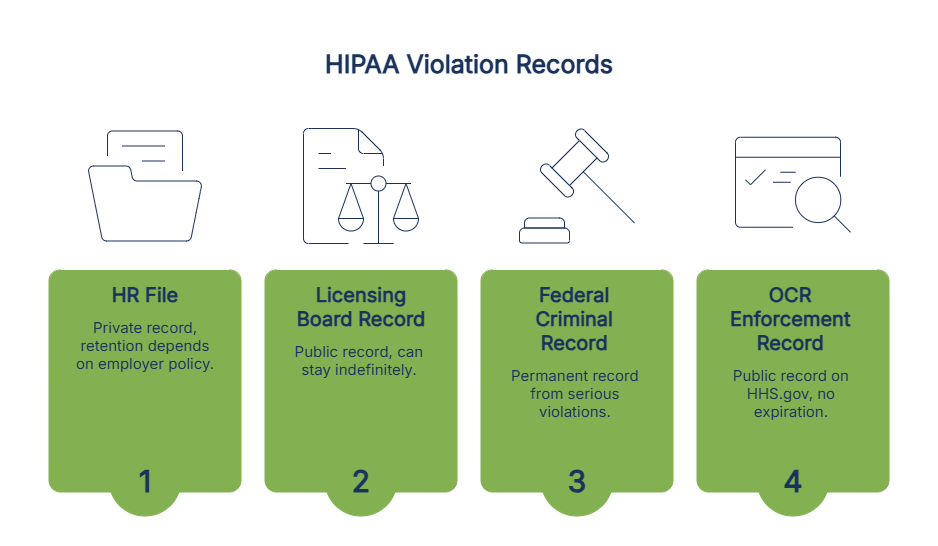
Your Employment and HR Disciplinary File
The employment file is typically the first place a HIPAA violation lands. When a violation is reported internally, your employer documents it in your HR file as part of their standard disciplinary process.
This file is private. It is not shared with the government or any licensing board unless the violation is serious enough to trigger a separate report. How long it stays there is not set by any federal law specific to employment records. It depends entirely on the employer’s own retention policy. Depending on the severity of the incident, that record could remain in your file for the duration of your employment or even beyond.
Your Professional Licensing Board Record
Your HR file and your professional license are two completely different things. State licensing boards for nurses, physicians, and allied health professionals maintain their own disciplinary records independent of what any employer decides. If a serious HIPAA violation is reported to a licensing board, the board may issue a formal notation on your public license record. That notation is typically posted on the board’s website and can stay there indefinitely, even if your employer took no action or chose not to terminate your employment.
Your Federal Criminal Record Under §1177
For the most serious violations, HIPAA enforcement can reach the level of federal criminal prosecution. Section 1177 of the Social Security Act makes it a federal crime to obtain or disclose individually identifiable health information without authorization, knowingly.
A conviction under this statute creates a permanent federal criminal record, one that does not expire, cannot be erased through an employer’s internal policy review, and will appear on criminal background checks for life.
OCR’s Public Enforcement Record on HHS.gov
When OCR takes formal enforcement action against a healthcare organization, that action is published on HHS.gov for the public to see. These records do not have an expiration date. Future business partners, insurance payers, and accreditation bodies can find them years or even decades later.
Even when a covered entity fully completes a corrective action plan and OCR closes its monitoring period, the original enforcement history stays permanently in the public database.
How Long a HIPAA Violation Stays on Your Employment Record
For most individuals, the employment record is where the concern hits first. You want to know whether this incident will follow you to your next job.
The honest answer is that federal law does not tell employers exactly how long they must keep disciplinary records tied to HIPAA. The duration is determined by two things:
- The employer’s internal sanctions policy
- HIPAA’s broader 6-year documentation retention requirement, which applies to compliance records generally
Minor and Unintentional Violations – Verbal Warnings and Retraining
Not every HIPAA violation results in a formal, permanent record. A first-time, low-severity incident, such as accidentally discussing a patient’s appointment in a hallway where others are within earshot, typically results in a verbal warning and mandatory retraining.
In many organizations, especially where the act was clearly unintentional and caused no patient harm, the incident may not be formally documented at all. Good-faith mistakes by employees with clean compliance histories are often handled informally, particularly in organizations that use tiered sanctions policies designed to match the response to the severity of the act.
Serious and Repeated Violations – Termination and What Remains on File
Serious violations are treated very differently. Deliberately accessing patient records without a work-related reason, sharing protected health information (PHI) with unauthorized people, or committing multiple smaller infractions over time: all of these typically result in formal written documentation that becomes a permanent part of the HR file.
If the employee is terminated, that termination record can surface in future employment reference checks and may impact hiring decisions, especially in healthcare settings where employers screen candidates carefully. When criminal conduct is involved, the consequences extend well beyond the HR file.
Will a HIPAA Violation Show Up on a Background Check?
This is one of the most common questions people have, and the answer is more specific than most people expect. A HIPAA violation will appear on a standard criminal background check only if it resulted in a criminal conviction under §1177 of the Social Security Act.
Routine employment background checks do not pull internal HR disciplinary records; those remain private within the employer’s system. However, if a violation crossed into criminal territory, such as knowingly obtaining or disclosing PHI, it can be charged as a federal misdemeanor or felony, and that conviction will appear permanently on criminal background checks regardless of how much time has passed.
Can You Be Rehired After a HIPAA Violation?
Rehiring is possible after a minor, first-offense HIPAA violation, particularly when there were no criminal charges and the employee demonstrated genuine accountability. However, if the violation led to termination for gross misconduct or resulted in a criminal conviction, healthcare employers are far less likely to take that risk.
Some employers also run OIG exclusion checks and licensing verification as part of their hiring process, and those checks can surface prior violations even when a criminal record has been sealed or expunged under state law.
How Employer Sanctions Policies Determine Record Duration
HIPAA requires covered entities to have a sanctions policy in place for workforce members who violate HIPAA rules. But HIPAA does not prescribe exactly how long those records must be kept, except that all compliance-related documentation falls under the general 6-year documentation retention rule.
Most organizations build tiered sanctions structures with 4 levels: verbal warning, written warning, suspension, and termination, and each tier generates different levels of documentation with different consequences for how that record follows the employee over time.
From Warning to Termination – How Employers Handle HIPAA Violations
Not every HIPAA violation leads to the same outcome, and that is intentional. Employers are expected to apply sanctions that fit the severity of the incident. The way an organization responds to a violation and what it documents along the way can have lasting consequences for both the employee and the organization itself.
What Factors Employers Weigh Before Terminating
Before deciding on any action, employers take into account several factors:
- Was the violation intentional or accidental?
- Was PHI actually disclosed, or was it only at risk of being disclosed?
- Did the employee report the incident voluntarily?
- Does the employee have a history of prior compliance failures?
- What was the actual or potential harm to the patient?
Organizations with strict sanctions policies may terminate even for a first offense if the act involved deliberate concealment or malicious intent. Those with more flexible rules give employees a path to correction through retraining and closer monitoring.
First Offense vs. Repeat Violations – How Prior History Affects the Outcome
Most sanctions policies treat genuine first offenses more leniently unless the act involved a clear intent to harm or profit from the disclosure. A second or third violation, even if each individual incident seems minor, is typically escalated to the next tier of the sanctions policy.
Employers are required to document this pattern, and that escalation history becomes part of the employee’s permanent HR record. Future disciplinary decisions involving that same employee will be made in the context of everything that came before.
Can You Get Fired for an Accidental HIPAA Violation?
Yes, it is possible to be terminated for an accidental HIPAA violation, but it is not the typical outcome. Termination for an accidental incident usually only happens when the violation was serious in nature, caused real patient harm, or followed a prior history of similar cases.
A genuinely accidental, good-faith violation with no patient harm and no prior violations typically results in corrective training rather than dismissal. That said, employers are not legally required to offer leniency. Their sanctions policy governs the response, and some policies are strict across the board.
What to Do If You Are Accused of a HIPAA Violation – Escalating to a Privacy Officer
If you are accused of a HIPAA violation, even if you believe the accusation is unfair or inaccurate, the right move is to escalate to your organization’s Privacy Officer right away.
Do not try to explain it away informally or delay reporting while hoping it resolves itself. Attempts to hide or minimize an incident consistently lead to worse outcomes than transparent, early reporting.
If the accusation turns out to be unfounded, the Privacy Officer can work to resolve it officially. If it is justified, early involvement limits the damage and demonstrates good faith, which directly affects the severity of the sanction the organization applies.
Criminal and Civil Penalties and Their Impact on Your Record
Beyond the employment file, HIPAA violations may lead to federal enforcement actions that result in lasting legal and financial consequences. It is important to understand the difference: criminal penalties apply to individuals, while civil monetary penalties are typically imposed on covered entities as organizations. Both types of enforcement records outlast the incident that triggered them, and neither disappears on its own.
Three Tiers of Federal Criminal Penalties and Jail Time
Section 1177 of the Social Security Act sets out three tiers of criminal penalties based on the nature and intent behind the violation:
- Tier 1 – Knowingly obtaining or disclosing PHI: Up to 1 year in prison and a $50,000 fine.
- Tier 2 – Violations committed under false pretenses: Up to 5 years in prison and a $100,000 fine.
- Tier 3 – Violations for personal gain, commercial advantage, or malicious harm: Up to 10 years in prison and a $250,000 fine.
One important clarification: the word “knowingly” does not mean the person knew they were violating HIPAA. It means only that they knew what they were doing, for example, that they were accessing records they had no clinical reason to view. The intent to break the law is not required for prosecution.
The Additional 2-Year Sentence for Aggravated Identity Theft
When a HIPAA criminal violation also involves identity theft, such as using a patient’s personal information to open fraudulent financial accounts, an additional mandatory 2-year consecutive sentence can be added under 18 U.S.C. § 1028A.
This sentence runs consecutively, not at the same time as the underlying HIPAA criminal penalty. Courts cannot place individuals convicted under this statute on probation instead of the additional sentence. For the most serious cases, this brings the maximum potential sentence to 12 years.
How the DOJ and OCR Divide Enforcement Responsibility
OCR handles civil enforcement of HIPAA: investigating complaints, issuing corrective action plans, and imposing civil monetary penalties on covered entities and business associates.
When a violation crosses into criminal territory, OCR refers the case to the Department of Justice, which prosecutes under §1177 of the Social Security Act. Both agencies maintain their own enforcement records, and neither routinely removes those records after a fixed period of time.
Civil Monetary Penalty Tiers – From Unknowing to Willful Neglect
The civil penalty structure has four tiers, adjusted annually for inflation. The current 2026 figures from HHS enforcement guidance are as follows:
Tier | Culpability Level | Minimum Per Violation | Maximum Per Violation | Annual Cap |
1 | Unknowing | $145 | $73,011 | $2,190,294 |
2 | Reasonable Cause | $1,461 | $73,011 | $2,190,294 |
3 | Willful Neglect – Corrected Within 30 Days | $14,602 | $73,011 | $2,190,294 |
4 | Willful Neglect – Not Corrected | $73,011 | $2,190,294 | $2,190,294 |
The annual cap in the table above applies per violation category, not as a total ceiling on what an organization can owe. If OCR investigates and finds failures across multiple HIPAA requirements, each failed requirement carries its own separate cap. An organization found to have violated three distinct rules does not pay up to $2,190,294 total. It faces up to $2,190,294 for each violation category. For organizations with widespread compliance gaps, the real financial exposure can be a multiple of what the table suggests.
Corrective Action Plans – Duration and Ongoing Monitoring
When OCR resolves a case through a corrective action plan rather than a direct financial penalty, the organization enters a monitoring period. Based on published resolution agreements, these periods generally run 1 to 3 years. During that time, OCR requires regular compliance status reports and has the right to request documentation at any point.
Once the monitoring period ends and OCR closes the matter, the organization is released from active oversight, but the resolution agreement itself remains permanently accessible on HHS.gov. Future payers, partners, and auditors will be able to find it.
Can a Civil Penalty or Enforcement Action Ever Be Removed?
No. There is no federal expungement process for HIPAA civil enforcement actions. Once OCR publishes an enforcement record on HHS.gov, it stays there permanently. An organization can demonstrate outstanding compliance in the years that follow, and that positive track record will matter in future dealings with payers and regulators, yet the original enforcement action stays on the public record regardless. Auditors, insurers, and business partners who conduct due diligence reviews will find it.
Exclusion From Medicare as a Consequence of Non-Compliance
HHS has the authority to exclude covered entities from Medicare participation for non-compliance with HIPAA transaction and code set standards. For healthcare providers who depend on Medicare reimbursement, this is one of the most significant financial consequences possible.
Exclusions are tracked and published by the OIG in its exclusion database, another public record that does not disappear once an organization is listed, and one that directly affects the organization’s ability to operate.
Can a HIPAA Violation Cost You Your Healthcare License?
Most healthcare professionals think about the employment consequences of a HIPAA violation first. But there is a third record that can affect a career long after the employment matter is settled: the state professional license.
Licensing board actions operate entirely independently from what an employer decides. You can keep your job and still face a board inquiry. You can be terminated and never hear from the board at all. These two tracks run in parallel, and both can have lasting effects.
How State Licensing Boards Learn About HIPAA Violations
Licensing boards learn about HIPAA violations through three channels:
- Mandatory self-reporting: Several states require healthcare professionals to self-report disciplinary actions, including terminations for cause.
- Employer notification: When a covered entity terminates an employee for a HIPAA-related violation, the employer may be required to notify the relevant licensing board.
- Referrals from OCR or law enforcement: Serious civil or criminal enforcement actions are often referred to the appropriate licensing authority.
Not every violation triggers a board report. It is primarily serious and criminal misconduct that reaches this level.
License Suspension, Revocation, and the Appeals Process
When a licensing board opens an investigation, outcomes range from a formal written reprimand to full license revocation. The practitioner has the right to respond to the complaint and appeal any adverse decision through the board’s formal process. In most states, all board decisions and disciplinary notations are published on a publicly searchable website, meaning anyone can look up a practitioner’s disciplinary history.
Nursing, Physician, and Allied Health: Different Boards, Different Rules
The rules are not uniform across professions or states. Each healthcare profession is governed by its own state licensing board, with its own investigation processes and enforcement standards.
A violation serious enough to result in license revocation for a nurse in one state might result only in a reprimand or additional training requirement for a physician in another. Practitioners who hold licenses in more than one state may face separate proceedings in each jurisdiction with potentially different outcomes in each one. This is a meaningful risk for traveling healthcare workers and telehealth providers.
Credentialing Bodies and Payer Contracts – The Hidden Long-Term Career Impact
The professional license is not the only credential that matters. Healthcare professionals are also credentialed by the hospitals, health systems, and insurance payers they work with.
A HIPAA violation, even one that does not result in license suspension, can trigger a credentialing review. That review may restrict hospital privileges or disqualify a provider from participating in payer networks. A practitioner can hold a valid, unrestricted license and still find their practical ability to work in healthcare meaningfully limited because of credentialing consequences that the state board never formally imposed.
Can You Practice Again After Losing Your License Over a HIPAA Violation?
License revocation is not always a permanent end to a career. Most states have a reinstatement process that requires the practitioner to display real rehabilitation, complete additional training, and petition the licensing board after a defined waiting period.
However, a criminal HIPAA conviction significantly complicates and, in some cases, permanently forecloses any reinstatement path. The specific outcome varies considerably by state, profession, and the details of the original violation. Anyone dealing with this situation should work with legal counsel who specializes in professional licensing.
How Long HIPAA Violation Documentation Must Be Retained
Most people focus on how long a violation “stays” on their record. But healthcare organizations also need to understand a related question with real legal consequences: how long are they required by law to keep documentation of violations, investigations, and corrective actions? The answer is grounded in federal regulation, with important variations driven by state law.
The 6-Year Rule: What It Covers and When the Clock Starts
Under 45 CFR §164.316(b)(2)(i) and 45 CFR §164.530, covered entities and business associates must retain HIPAA compliance documentation for a minimum of 6 years from the date the document was created or the date it was last in effect, whichever is later.
The “last in effect” language is important and often misunderstood. The 6-year clock does not start from the day a document was written. It starts from the last day it was actively being used. For example, a policy written in 2015 but replaced in 2020 must be retained until 2026, not 2021. The starting point is 2020, when the policy was last in effect, not 2015 when it was created.
It is also worth noting that HIPAA’s 6-year rule only preempts state law when a state requires a shorter retention period for compliance documentation. When state law requires longer retention, organizations must follow the stricter state standard, and that obligation is not optional.
What Documents Are Subject to HIPAA Retention Requirements
The following document types are all subject to the 6-year minimum:
- Privacy and security policies and procedures
- Risk assessments and risk analyses
- Staff HIPAA training records
- Business associate agreements
- Incident and breach notification documentation
- Complaint and resolution records
- Workforce sanctions policies
- Notices of privacy practices
- Authorizations for PHI disclosure
- Audit logs and access records
- Disaster recovery and contingency plans
- IT security system reviews
Why Some Organizations Retain Records for 7-10 Years
HIPAA sets the minimum, but other requirements commonly push organizations to keep records longer. The Centers for Medicare and Medicaid Services (CMS) requires Medicare managed care program providers to retain records for 10 years. Many organizations adopt a uniform 7–10 year window to reduce audit risk and avoid the complications of managing different timelines for different document types.
Audit Trails, Access Logs, and Evidence Preservation
HIPAA does not specify an exact retention period for access logs and audit trails, but organizations typically retain them for at least 6 years to align with the wider documentation retention requirements.
These logs are critical evidence in breach investigations and OCR audits, and they are consistently among the first items regulators request. Storing them on durable, access-controlled systems rather than local drives or shared folders is not a best practice. For any organization that handles PHI regularly, it is the baseline expectation.
Litigation Holds – When Routine Deletion Must Stop
When litigation, a government investigation, or an OCR inquiry is reasonably anticipated, the organization must immediately suspend its normal deletion schedule. A litigation hold overrides all standard retention timelines until the matter is fully resolved.
Deleting records after a hold should have been triggered, even as part of a routine process, and can be treated as destruction of evidence, which carries its own serious legal consequences.
Staff HIPAA Training Records and Online LMS Documentation
Training records must be retained for at least 6 years from creation or the date last in effect. For organizations using online learning management systems, this means preserving course completion records, session timestamps, quiz scores, user progress logs, and the training content itself.
These records are among the first things OCR asks for during an audit or investigation. If you cannot produce evidence that training occurred, you cannot demonstrate that your workforce was equipped to follow the rules.
Statute of Limitations and Its Role in Retention Decisions
Statutes of limitations for personal injury claims and breach of contract disputes vary by state, and in many cases, they extend well beyond HIPAA’s 6-year documentation baseline. If an organization disposes of records before the applicable statute of limitations has closed, it may find itself without the evidence needed to defend against a legal claim. A practical approach is to retain documentation for at least as long as the longest relevant statute of limitations inside each state where the organization operates.
Secure Disposal of HIPAA Documentation When Retention Periods Expire
When a document’s retention period ends, it cannot simply be deleted or recycled. HIPAA requires all PHI-related documentation to be destroyed in a way that prevents unauthorized reconstruction:
- Paper records: Shred, burn, pulp, or pulverize until the information is completely unreadable
- Electronic records: Use software-based overwriting, degaussing, or physical destruction of the storage media
Simply hitting delete or placing paper documents in a recycling bin does not meet HIPAA’s disposal standard.
HIPAA Violation Reporting and Resolution: What Gets Documented
Every step in a HIPAA violation investigation produces documentation, and all of that documentation must be retained under the 6-year rule. Understanding what each stage of the process generates helps organizations build a complete, defensible compliance record from the moment an incident is identified to the moment the case is formally closed.
Identifying and Containing the Incident
The first step after identifying a potential violation is containment, securing affected systems, restricting unauthorized access, and preventing any further disclosure of PHI. The organization should document the date and time of discovery, the systems or records involved, and every containment action taken. This initial incident report is the foundation of the entire compliance record for that event, and it is typically the first thing OCR requests if they open an investigation.
Conducting and Documenting the Risk Assessment
Once the incident is contained, a formal risk assessment must be conducted to determine whether the incident constitutes a reportable breach. The assessment must evaluate four factors:
- The nature and extent of the PHI involved
- Who accessed the information, and whether they were authorized
- Whether the PHI was actually viewed or acquired
- The degree to which the risk to affected individuals has been mitigated
This risk assessment must be fully documented and retained even if the conclusion is that no reportable breach occurred.
When Breach Notification Is Required – The 60-Day Rule and Individual Notice
If the risk assessment confirms a reportable breach, covered entities must notify affected individuals without unreasonable delay and no later than 60 days after discovering the breach. When a breach affects more than 500 residents of a state or jurisdiction, prominent media notification is also required within the same 60-day window.
Breaches affecting 500 or more individuals must be reported to HHS without delay, while smaller breaches may be logged and reported annually. Every notification letter, date, media contacts, and HHS submissions must be fully documented and retained.
Applying Sanctions, Retraining, and Corrective Actions
Once the investigation concludes, the organization must apply sanctions to the workforce members involved according to its sanctions policy. The documentation must include what sanction was applied, what retraining was completed and when, and what corrective measures were put in place to prevent recurrence. This record becomes part of both the employee’s HR file and the organization’s HIPAA compliance documentation, and both must be retained under the 6-year rule.
Closing the Case – Written Summaries, Lessons Learned, and Policy Updates
Every investigation must be formally closed in writing. The closure document should include:
- A summary of what happened
- The investigation findings
- The sanctions applied
- The corrective actions taken
- Lessons learned for the organization
Any policy or procedure updates that resulted from the incident should be linked directly to the incident record. This document is one of the first things OCR looks for when reviewing how an organization managed a reported breach.
What Happens if OCR Investigates – Voluntary Compliance vs. Civil Penalties
OCR may investigate following a complaint or a large breach notification. Its process begins by reviewing whether the covered entity is in compliance. If gaps are found, OCR first attempts to resolve the matter through voluntary compliance, a corrective action plan, or a resolution agreement. If the organization fails to cooperate or address the identified failures, OCR can impose civil monetary penalties.
Every piece of OCR correspondence, every letter, every response, every signed resolution agreement must be retained and become a permanent part of the enforcement record on HHS.gov.
Record Keeping Best Practices to Protect Your Organization
Maintaining proper HIPAA violation records is not only a compliance obligation, but it is also your organization’s first line of defense in an audit, an investigation, or a lawsuit.
When your documentation is complete, accurate, and well-organized, it tells the story of an organization that understood its obligations, responded appropriately when problems arose, and built real systems to prevent them from recurring.
Setting a Retention Policy That Complies With HIPAA and State Requirements
Start by creating a written record retention policy that sets a 6-year minimum for all HIPAA compliance documentation and extends that minimum to match the longest applicable state requirement or statute of limitations in your jurisdiction.
The policy should specify retention periods by document type, assign clear ownership to particular roles, and be reviewed at least once a year. One thing worth noting: the retention policy itself is a HIPAA compliance document, which means it also falls under the 6-year retention requirement.
Centralizing Incident Reports, Risk Assessments, and Sanction Documentation
Violation-related documentation that is scattered across email inboxes, shared drives, and paper folders creates a real risk during audits, not because the records do not exist, but because they cannot be found quickly and completely.
Centralizing all incident documentation in a single controlled compliance repository makes audit responses faster, reduces the chance of missing a key document, and secures consistent retention scheduling across all record types. This is one of the most practical and influential steps any compliance team can take.
Role-Based Access, Encryption, and Chain of Custody for Violation Files
Violation files contain sensitive information about both patients and employees. Protect them accordingly:
- Apply role-based access controls so only authorized compliance personnel can view or edit records
- Encrypt all stored files
- Maintain an access log that documents who accessed each record, when, and for what purpose.
This protects the organization from internal tampering and demonstrates strong security practices to any auditor who reviews the files.
Automating Retention Schedules and Legal Hold Triggers
Managing retention schedules manually via spreadsheets creates unnecessary risk. Human error is inevitable, and missed review dates create compliance exposure. ComplyAssistant’s GRC software allows organizations to set tasks for reviewing documentation as retention deadlines approach, ensuring records are assessed on time rather than overlooked. When a document is updated or replaced, the archiving feature automatically saves the outdated version alongside the new one, preserving the full document history. This creates an auditable trail of every retention decision the organization makes.
Documenting Remediation to Demonstrate Continuous Compliance
What the organization did after a violation matters just as much as how it handled the investigation. Document every remediation step: policy updates made, technical controls added, additional training delivered, and vendor contracts revised.
This remediation record shows OCR, accreditation bodies, and payers that the organization took the violation seriously and put lasting improvements in place. It is also the primary evidence used when seeking reduced penalties if a future enforcement action occurs.
How ComplyAssistant Helps You Manage HIPAA Violations and Stay Audit-Ready
ComplyAssistant is a healthcare GRC software and cybersecurity services company with over 25 years of experience helping healthcare organizations build compliance programs that hold up under scrutiny.
The challenges covered in this article, preventing violations, managing documentation, and surviving audits, are exactly what ComplyAssistant is built for.
- Proactive Prevention Through Policy Management and Risk Assessments: Structured templates, automated workflows, and real-time gap visibility keep compliance programs current and reduce the chance of an undetected issue turning into a reportable violation.
- Centralized Violation Documentation Retained to HIPAA and State Standards: All incident documentation, breach notifications, sanctions records, and corrective action plans are stored in one controlled portal with retention schedules built in and configurable by state.
- HIPAA Audits, Virtual CISO Services, and Directive Action Plans: Audit findings delivered inside the software with a clear action plan attached. Virtual CISO support keeps compliance moving between audits so nothing falls through the gaps.
- Vendor Risk Management to Reduce Third-Party Breach Exposure: Tracks business associate agreements and vendor security practices, flagging relationships that need attention before a vendor incident becomes the covered entity’s problem.
If keeping violation records, managing audits, and staying on top of state and federal retention requirements feels overwhelming, ComplyAssistant is built for exactly that. Contact the ComplyAssistant Team and take the next step toward a stronger compliance program.
Wrapping Up!
One of the most common questions in healthcare compliance is, “How long does a HIPAA violation stay on your record?”, and as this guide has shown, the answer is not simple. It depends on the type of record, who maintains it, and the circumstances of the violation itself. Some records fade with time. Others do not go away at all.
What stays constant is this: the best protection for any healthcare organization is a compliance program strong enough to prevent violations in the first place and thorough enough to document everything properly when they do occur. That kind of program does not build itself.
ComplyAssistant works with healthcare organizations every day to build exactly that. Visit the ComplyAssistant website today to learn how the right tools and expert support can keep your organization ahead of compliance obligations.
FAQs
Does a HIPAA violation stay on your record permanently?
It depends on the type of record. Criminal HIPAA violations under §1177 and OCR public enforcement actions on HHS.gov remain permanently. Employment HR records follow employer policy and may be retained for the duration of employment or longer. Licensing board notations vary by state board rules and the severity of the violation.
How long does HIPAA require violation documentation to be retained?
HIPAA requires covered entities and business associates to retain compliance documentation, including violation records, risk assessments, breach notifications, and sanctions records, for a minimum of 6 years from creation or the date last in effect. State law, accreditation bodies, or payer contracts may require longer retention periods.
Will a HIPAA violation show up on a background check?
Only if the violation resulted in a criminal conviction under §1177 of the Social Security Act, standard employment background checks do not access internal HR disciplinary files. Criminal HIPAA violations charged as federal misdemeanors or felonies will appear on criminal background checks.
Does every HIPAA violation result in termination?
No. Minor, first-time violations typically result in retraining and a verbal warning. Termination is usually reserved for willful or intentional violations, gross misconduct, or repeated offenses. The specific outcome depends entirely on the employer’s sanctions policy and how consistently it is applied.
What is the difference between HIPAA record retention and HIPAA data retention?
HIPAA record retention refers to compliance documentation: policies, risk assessments, training records, and breach files, which must be kept for 6 years. HIPAA data retention refers to PHI in patient medical records, for which HIPAA sets no retention period. Medical record retention is governed entirely by state law.
How can compliance software help prevent HIPAA violations from ending up on your record?
Tools like ComplyAssistant help organizations maintain current policies, conduct risk assessments, and document everything correctly, reducing the chance a gap turns into a reportable violation and ensuring records are defensible if one does occur.
